Music Resources > Afro-Cuban Music > Afro-Cuban Bass
The Bass in Afro-Cuban Music
Roots of the Bass in Son Cubano
In Afro-Cuban music, more specifically the son cubano and its evolved forms, the bass plays a melodic role as well as a rhythmic role.
One predecessor of the string bass came from Africa to eastern Cuba during international slave trade. This ancestor is the marímbula, a large wooden box on which a player would sit and pluck large metal tabs. In early son, the marímbula provided both the melodic foundation and a rhythmic role. It was typical for the marimbulero to add rhythmic affect and structural cues by striking or beating the box. This tradition carried over to Havana and the USA with bassists like Orlando “Cachaito” Lopez, often seen striking the body and fingerboard of his bass.
By 1910, the son cubano in the eastern (Santiago) region of Cuba had reached Havana in the west, and the string bass, which could provide much more melodic support, became the mainstay. The trend of Western Classical instruments combining with African traditions would be a worldwide trend, as it had been in the Iberian Peninsula; and it was no exception in Cuba.
The Function of the Bass in Son Cubano
By the 1940’s, Havana bassists like Israel “Cachao” Lopez were applying their knowledge of Western Classical music to the son cubano. It’s here where the son the contradanza marry, and the mambo—a mix of African rhythmic and melodic elements from Santiago, with the harmonic and structural elements of Western Classical contradanzas popular in Havana–was born. Let’s explore some examples of this in the Cuban mambo, cha-cha-cha and danzón.
Example #1: Mambo
In the mambo and other evolved forms of son cubano, the bass plays an elegant syncopated pattern called a tumbao, which acts to both solidify and provide tension to the rhythm, while outlining the harmony of the composition.
Here is a typical mambo bass tumbao, played by Cachao on the tune “Mambo”:

I’d like to point out three main aspects of the tumbao: rhythmic enforcement, tension, and harmony.
Firstly, the bass provides rhythmic enforcement by outlining the “3” side of the 2-measure son clave pattern:
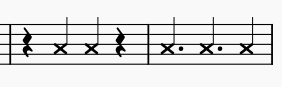
In one way or another, all Afro-Cuban music (written in 4/4 and played in 2/4) is based off this son clave pattern.
Like the son clave, the bass tumbao is two measures long. Notice how the tumbao corresponds to the “3” side of the clave pattern, while syncopating with the “2” side:

On the “2” side, the bass syncopates on the and-of-2. On the “3” side, the bass syncopates on beat 3.
It’s possible to simplify this pattern to make it easier to learn. On an earlier recording of “Mambo”, Cachao omits a note on the and-of-2, so that minimal syncopation is happening on the “2” side:
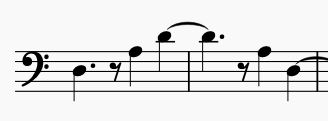
On the “3” side, the bass has the option of syncopating on beat 3, or lining up with the clave more directly, as typical in son guaracha:

Secondly, all of these variations of the tumbao provide a strong harmonic foundation, rooting the entire orchestra in a tonic key.
Example #2: Cha-cha-cha
The cha-cha-cha, not mutually exclusive from the mambo, has a different tumbao. This time the bass plays a 1-measure pattern that provides a bit of tension on both sides of the son-clave pattern.

On the “2” side, the bass syncopates on the and-of-2. On the “3” side, the bass syncopates on beat 2.
Example #3: Danzón
One more aspect of Afro-Cuban bass that I want to highlight is the sophistication. In this excerpt of Cachao’s arrangement of “Isora Club,” he constantly moves back and forth between pizzicato and arco (bowed). During the closed song-form part of this danzón, he supplies lots of melodic and harmonic information. During the montuno sections, he plays entirely pizzicato, while providing other rhythmic effects.

The bass, both “singing” and providing rhythmic variation, pushes and pulls tension against the danzón bell pattern:
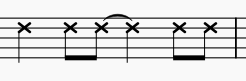
It is evident here that in the son, mambo, salsa, and Latin jazz, the bass must sing, provide rhythmic cues, and provide rhythmic tension and supplementation.
Resources
Readings
From Afro-Cuban Rhythms to Latin Jazz by Raul A. Fernandez
Instruction Books
The True Cuban Bass by Carlos Del Puerto & Silvio Vergara
The Latin Bass Book by Oscar Stagnaro & Chuck Sher
Videos
Orlando “Cachaito” Lopez – World Circuit Record Documentary
“Mambo” – Cachao
“Mambo” – Orquesta Arcaño y sus Maravillas
“Mambo No. 5” – Perez Prado
“Isora Club” – Cachao